|
149 |
PPACA or AHCA? Or Single Payer. |
||||||||||
|
|
This page has been set up to describe Why the USA spends most on healthcare, but isn't healthiest.
|
||||||||||
|
Duke University Hospital has 900 beds. |
One example Cutler brought up in a discussion on this topic with National Public Radio was the 1,300 billing clerks at Duke University Hospital, which has 900 beds. Those billing specialists are needed to determine how to bill to meet the varying requirements of multiple insurers. Duke Hospital has 3457 doctors and 3428 nurses. Recent data was 40,326 admissions. About 31 cases per billings clerk - less than 1 per week. Seems a low number? |
|
Thats about 1.5 clerks PER BED! |
Canada and other countries that have a single-payer system dont require this level of staffing to administer healthcare. |
|
Medical records. Some say shared records is a bad idea * |
Is there a joined up system of medical records in the USA system? Would a person from New York hospitalised in California have medical records available? If not, a whole series of tests etc could be needed = more costs. I have heard of a system of mobile medical facilities proposed by ATP spokesman David J Sponheim. This amounts to an "outpatients" department or a "walk in centre". The same would apply there and services provided would be restricted. |
|
The Medicaid program is jointly funded by states and the federal government. From taxes on all to cover the poorest in society. |
Several states have opted to reject the expanded Medicaid coverage provided for by the PPACA act; over half of the nation's uninsured live in those states. They include Texas, Florida, Kansas, Georgia, Louisiana, Alabama, and Mississippi. Some Republican controlled states are probably behind the "impending implosion" or failure of the PPACA. The same applies to the delay in actually passing any other legislation. Trump is (er) trumpeting about something his party has actually been engineering! They have had EIGHT years to produce something "better". |
|
Republican Opposition to PPACA. |
What, exactly is the reason why Republicans hate the PPACA so much? it has reduced the numbers without coverage, and thus demands on Medicaid. Many shout repeatedly about the mandate element. I can't see any reasons why those who can afford insurance should not have it. Opting out is not allowed for auto insurance, so why should it be for medical insurance? How can they wish to reduce Medicaid funding at the same time as their proposals mean that more people will actually need it? The maths doesn't work out! |
|
Republican proposals (after 8 years of criticising "Obamacare" they cannot, so far agree on a plan to replace it.) |
Under 2017 American Health Care Act (AHCA) legislation under the House and Senate, both versions of proposed Republican bills have proposed cuts to Medicaid funding on differing timelines. Under both bills, the Congressional Budget Office has rated these as reducing coverage of Americans by Medicaid, with the Senate bill reducing costs of Medicaid by the year 2026 with a reduction of cost by 26 percent in comparison to projections of ACA subsidies. Additionally, CBO estimated have predicted number of uninsured rising under AHCA from 28 million persons to 49 million (under the Senate bill) or to 51 (under the House Bill) |
|
Unlike Medicaid, Medicare is a social insurance program funded at the federal level and focuses primarily on the older population. As stated in the CMS website, Medicare is a health insurance program for people age 65 or older, people under age 65 with certain disabilities, and (through the End Stage Renal Disease Program) people of all ages with end-stage renal disease. The Medicare Program provides a Medicare part A which covers hospital bills, Medicare Part B which covers medical insurance coverage, and Medicare Part D which covers prescription drugs. It is not evenly applied in every state, so moving your residence could present you with problems. |
|
Similarities to single payer. |
In effect, both Medicaid and Medicare are similar to the single payer system in that funding is derived from general taxation at either Federal or State level. They are not, however consistently applied nationwide. |
|
Or Single Payer. |
|
|
Example of a Single Payer system. |
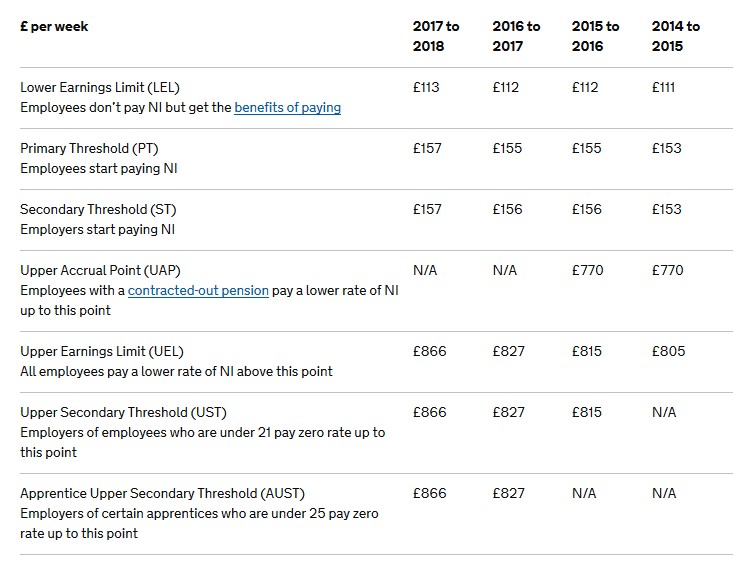
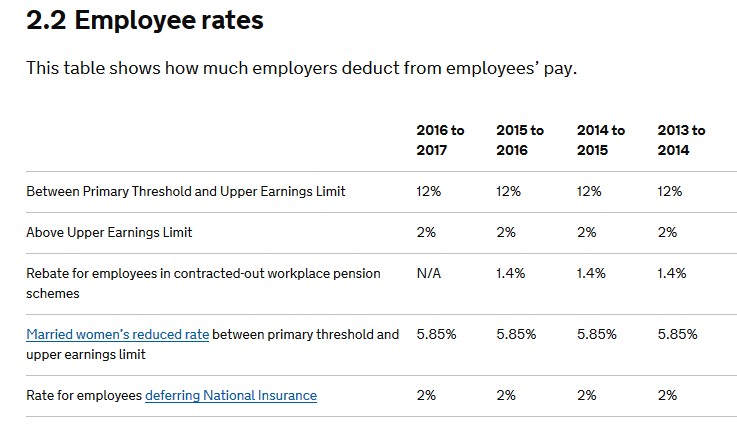
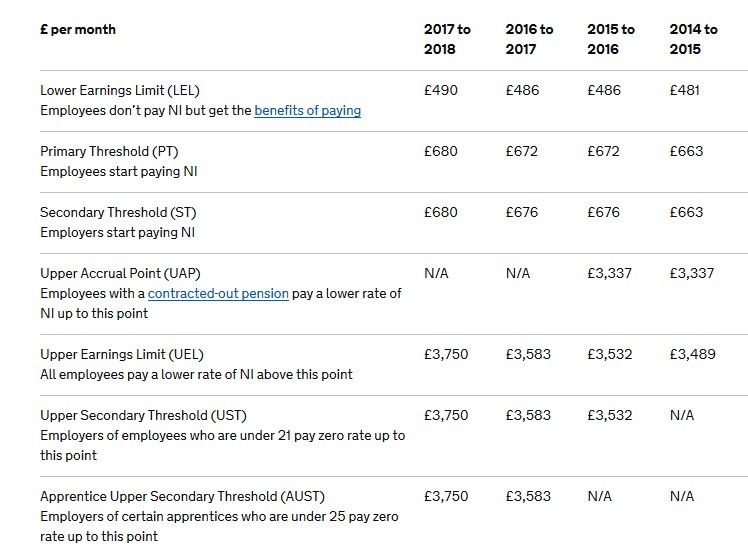
UK National Insurance (single payer) rates |
|
Income tax free allowance. |
Personal Allowance Up to £11,500. |
|
No NI is paid below the LEL. A rate if 12% applies between LEL and UEL A rate of 2% applies above UEL Note the last 2 lines referring to employers. |
|
|
On the upper earnings limit. |
Someone earning £866 a week would, therefore pay £85.08 a week in National Insurance or £368.68 a month or £4,424.16 a year. That on a salary of £45,032.00 per annum. |
|
Above the limit. |
A person earning £1,000.00 a week would pay 2% on £134.00 or £2.68 a week in addition to that detailed above. A person earning £100,000.00 per annum would pay 2% on £54,968 or £1099.36 or £5,523.52 in total. |
|
|
|
|
|
Page created 15th. July 2017. Last edit 3rd September 2017. |