|
One company worth a close look is London-based drug delivery group
SkyePharma Plc, which is on the threshold of achieving maturity and
offers considerable growth potential. The good news is that the
shares (SKYE: news, chart, profile) are still reasonably cheap and
have yet to attract a glamour rating enjoyed by so many "jam
tomorrow" businesses in the US.
But perceptions are likely to change as its 2002 results, due within
a month, and a patent issue, remove some of the uncertainty
overhanging the stock.
SkyePharma develops novel devices and processes to improve the way
existing medicines are administered to patients. As a result, it
starts off with an advantage over pure biotech companies, which face
a considerable risk that a brand-new concoction made in the lab after
years of expensive research fails to get past regulatory hurdles.
The group's proprietary technology is of potential value to many drug
companies that either want to extend the patent life of their
existing drugs by adopting a new method of delivery, or to simply
improve the quality of treatment to patients. In return, SkyePharma
receives license payments as well as on-going royalties linked to
future sales of a drug.
The group has expertise in a wide range of methods of delivery. It
can make pills dissolve more slowly, once swallowed, so that the drug
works over a longer period. It can enable inhalers to work better so
that powdered-drugs they contain don't congeal with moist breath. Or
it can add a magic ingredient to an injection-delivered drug so that
patients need fewer jabs - a great boon for the many millions who
hate needles!
Not surprisingly, SkyePharma has commercial tie-ups with many drug
majors including GlaxoSmithKline (GSK: news, chart, profile) and
Novartis (NVS: news, chart, profile), which are applying its
technology to launch new versions of their big selling drugs.
The group has about a dozen projects for new drugs or approved
products on the market. That means it is now poised to transform from
a development stage company into a profitable business with growing
revenue streams, starting this year.
The big breakthrough is likely to come from Paxil CR, a faster-acting
version of Glaxo's blockbuster anti-depression drug. This drug has
been on sale since last year and U.S. doctors seem to like the newer
version. It now accounts for 32 percent of all new prescriptions
written for Paxil, suggesting that the newer version itself could
become a $1 billion a year drug.
SkyePharma gets a 3 percent royalty on Paxil CR sales, a small slice
from a mega-sized cake. On the other hand, the group is entitled to
fatter slices of royalties from its family of injectible painkillers
through its joint ventures with U.S.-based Enzon (which is planning a
merger with NPS Pharmaceuticals) and Endo. The royalty rate for one,
DepoMorphine, a post-operative painkiller, could be as high as 60
percent subject to sales targets being achieved. Developed by
SkyePharma, it is supposed to be filed for approval with the FDA
later this year.
Peter Laing, corporate communications director at SkyePharma, said
"This product has huge potential for us and could become more
important than Paxil CR. It is being described as revolutionary in
some circles."
Other exciting products on the way include a long-acting respiratory
drug, Foradil, owned by Swiss giant Novartis. The new version was
filed with the FDA last December and could be on the market by late
this year.
Meantime, expect positive news soon from SkyePharma's novel cream for pre-cancerous
skin ailments caused by too much sun. The product, Solaraze, was
approved for sale a year ago, but is only now gaining momentum after
SkyePharma relicensed marketing rights to Quintiles in the US and
Britain's Shire Pharmaceuticals in Europe and Australia.
SkyePharma's late-stage product pipeline means the group is expected
to move into profits this year. However, the shares have yet to catch
the limelight. One reason is that Glaxo's original patent on Paxil is
being challenged by generic drug makers in U.S. courts within a few
weeks. While the case does not directly affect Paxil CR, the newer
version, Laing concedes that it may have some knock-on effect on its
future sales potential.
Even so, the upside potential for SkyePharma is much greater than the
downside risk for long-term investors. At a guess, the odds of Glaxo
winning its case are more than even. Victory could also be a big
boost for SkyePharma and perhaps help to double its share price over
the next 12 months. Lose, and the shares could easily halve.
Another drag on the share price is that the group will remain heavily
reliant on one-off payments from deal making until royalty streams
build up over the next few years.
Still, investors are likely to gain more confidence once it reports
its 2002 results. Some British investors want to be see it deliver on
its promise to report a significant profit for the year. That will
depend on whether it can book a $25 million license payment from Endo
in last year's results or this year.
But this has become an issue tied-up in emotion. What matters more is
that the money is already in SkyePharma's bank account and has helped
to swell its estimated cash balances to about a $100 million. The
group was also cash flow neutral in the first half and a full year
profit of any size should warm investor sentiment.
Valuing SkyePharma is still dependent on forecasting future sales of
drugs. However, on current market estimates the group should move
into profits of about 6 million British pounds in 2002 and surge
five-fold by 2004 as new products hit drug stores. Group revenues are
expected to triple from a reported 46 million in 2001.
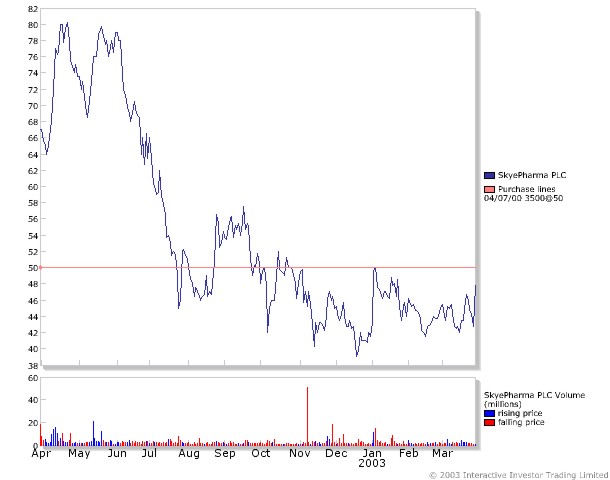
At 45 pence a share in Britain, or $7.09 for Nasdaq-listed shares,
the stock is valued at about 17 times expected earnings for this year
-- appealing for the risk tolerant investors looking for a high
reward/high risk play. |